
Your garage door spring is one of the hardest working components in your entire system. Whether you have a torsion spring mounted above the door or extension springs running along the sides, these components bear the full weight of the door every single time it opens and closes. Over time, that constant tension takes a toll.
Garage door spring problems don’t always announce themselves with a dramatic failure. Sometimes it’s a subtle jerk, an unusual noise, or a door that just feels heavier than it used to. Ignoring these early warning signs can turn a simple repair into a safety hazard, and in some cases, a snapped spring under tension can cause serious damage or injury. If you’re a homeowner in League City, TX, and you encounter any of these issues, you can contact our professional garage door spring repair team in League City for help.
Knowing what to look for can save you time, money, and a whole lot of frustration. Here are the five most common garage door spring problems and the warning signs you need to watch for.
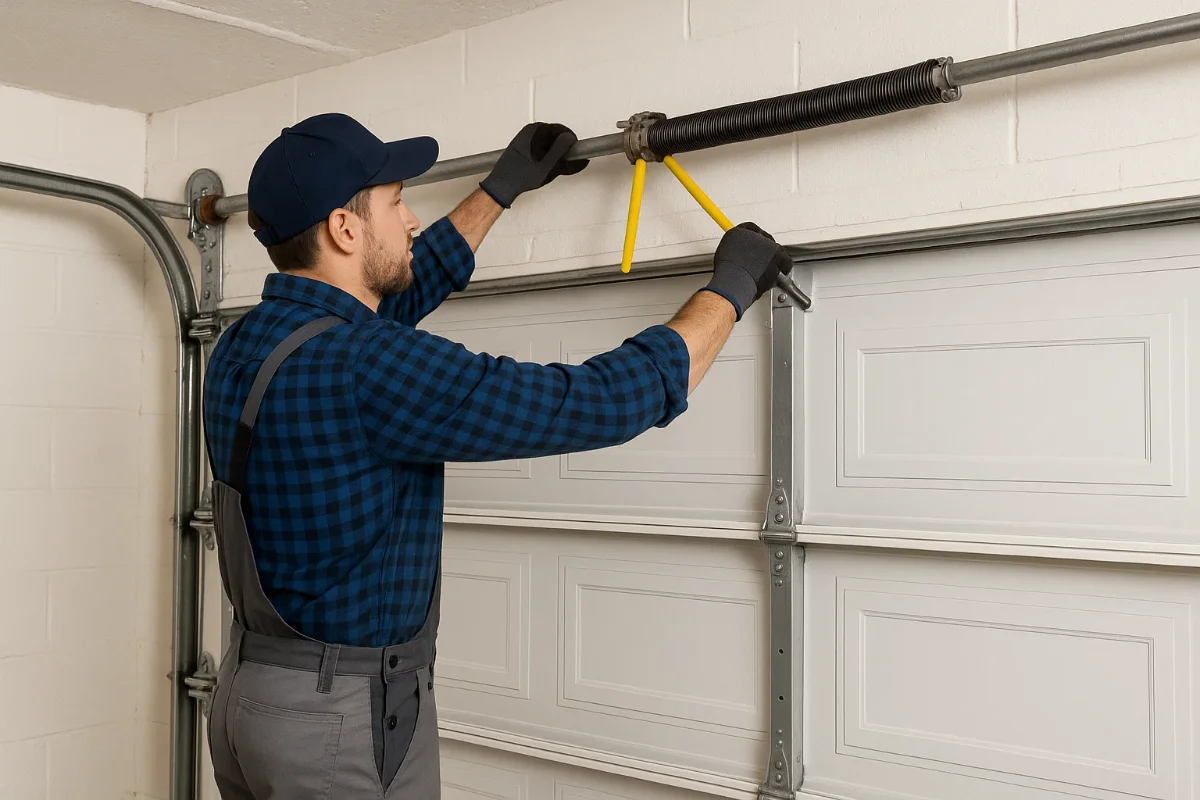
One of the most telling signs of garage door spring problems is a door that suddenly feels too heavy to lift or won’t stay open on its own. Under normal conditions, your springs, whether torsion or extension, counterbalance the full weight of the door, making it feel almost weightless when you move it manually. When that balance is gone, you feel it immediately.
Try the manual lift test: disconnect your opener and lift the door to about waist height, then let go. A properly balanced door will stay in place. If it drops to the ground or creeps back down, your springs have lost their tension and are no longer doing their job.
This puts your entire system under strain. The garage door opener motor compensates by working harder than it was designed to, which shortens its lifespan and can lead to burnout. Cables bear extra load they were never meant to handle alone, increasing the risk of a snap. What starts as a spring issue quickly becomes a multi-component repair if left unaddressed.
Springs naturally lose tension over thousands of cycles. The average garage door opens and closes around 1,500 times a year, and most springs are rated for 10,000 cycles. In humid climates like League City, TX, moisture accelerates metal fatigue and corrosion, meaning springs can wear out faster than their rated lifespan. Homeowners here often see this issue sooner than expected, especially with older doors that have never had a spring inspection.
Do not ignore a heavy door. It is a clear signal that your spring system needs attention before the problem compounds into a costlier repair.
A garage door that jerks, shudders, or tilts to one side as it moves is a classic sign of uneven spring wear. Most residential garage doors use either two torsion springs or a pair of extension springs, one on each side. When one spring weakens or fails before the other, the door loses its balanced tension and the uneven load becomes visible in every cycle.
You might notice one side of the door rising faster than the other, or the door appearing lopsided mid-travel. In some cases, the jerking motion is subtle at first, easy to dismiss as a minor hiccup. But that imbalance is putting uneven stress on every connected component with every single use.
Rollers take the first hit. They are designed to glide smoothly along the tracks under balanced load, and when that balance is off, they wear unevenly and can crack or pop out of the track entirely. The tracks themselves can bow or bend under the strain, and cables on the weaker side get pulled at an angle they were never designed to handle. What began as a spring imbalance can quickly escalate into a roller repair, track repair, and cable repair all at once.
Use the same manual lift test here. Disconnect the opener, raise the door to waist height, and release it. A balanced door stays level and holds its position. If one side sags or the door tilts, you have a spring imbalance that needs to be corrected before it worsens.
Extension springs, commonly found in older garage door setups, are more prone to uneven wear since each spring works independently. Torsion springs above the door share the load more evenly, but they are not immune to this issue. In either case, forcing the door open or closed when you notice jerky movement is a mistake, as it accelerates wear on every part in the system.
Catching these garage door spring issues early, before they spread to rollers and tracks, is always the more affordable fix.
If you have ever heard a sudden, explosive bang coming from your garage, loud enough to make you jump, you have likely just witnessed a garage door spring snapping under full tension. It is one of the most startling sounds a homeowner can experience, and it is often described as sounding like a gunshot going off inside the garage.
This is not a coincidence. Torsion springs in particular store an enormous amount of mechanical energy to counterbalance the weight of the door. When the metal finally gives way after years of tension cycling, that stored energy releases all at once. The spring can fracture violently, and in some cases, sections of the broken spring can travel several feet from the point of failure.
After the snap, your garage door will likely stop working entirely, or it may drop suddenly if the opener was running at the time. Do not attempt to operate the door manually or with the opener after hearing this sound. The full weight of the door is now unsupported, and forcing it in either direction puts you, your opener, and your cables at serious risk.
Metal fatigue is the root cause here. Springs go through thousands of tension and release cycles over their lifespan, and the metal gradually weakens from the inside out. You will rarely see it coming. One cycle it holds, the next it does not. Cold snaps and humidity fluctuations in League City accelerate this process, causing the metal to contract, expand, and develop micro fractures faster than in more stable climates.
Never handle a broken spring yourself. Even after snapping, a fractured spring under residual tension can shift or release unexpectedly and cause serious injury. Clear the area, keep family members and pets away from the garage, and contact a professional garage door spring repair technician in League City to assess and replace the spring safely.
The loud bang is not just a scare, it is the clearest warning your spring system will ever give you.
Your garage door opener is designed to guide the door, not carry it. When your springs are failing, that distinction disappears, and the opener suddenly finds itself doing a job it was never built for. If you notice your opener humming louder than usual, straining audibly, stopping the door midway, or reversing back down without completing the cycle, a weakening spring is very likely the cause.
Modern openers have built-in load sensors that detect when the door is too heavy to move safely. When a failing spring forces the opener to work beyond its rated capacity, these sensors trigger a reversal or a full stop as a protective measure. Many homeowners mistake this for an opener malfunction and replace the motor, only to find the same problem returning because the root cause, the spring, was never addressed.
The mechanical reality is straightforward. A properly functioning spring system carries the vast majority of the door’s weight, leaving the opener to handle only a fraction of the load. A single torsion spring on a standard residential door can support 150 to 200 pounds. When that support disappears, every bit of that weight transfers directly to the opener motor, cables, and drive system. Running the opener under that kind of load repeatedly causes the motor to overheat, the drive gear to strip, and the circuit board to fail prematurely.
Opener repairs and replacements are significantly more expensive than a spring replacement. Catching torsion spring issues at this stage, before the opener burns out, is always the smarter and more cost effective path. If your door hesitates, strains, or stops midway, do not keep hitting the button hoping it will push through. Each attempt adds more wear to an already stressed system.
Schedule a spring inspection with a qualified technician as soon as you notice these symptoms. A professional can assess spring tension, remaining cycle life, and whether a repair or full replacement is the right call, before the problem takes your opener down with it.
Most garage door spring failures give you a visual warning before they give you an audible one. If you take a moment to actually look at your springs, rust patches, gaps between coils, or coils that appear stretched and spaced further apart than the rest are all signs that the spring is nearing the end of its service life.
A healthy spring has tightly wound, evenly spaced coils with a clean metal surface. Rust changes that picture fast. Corrosion does not just discolor the metal, it eats into the structural integrity of the coil, thinning the wire and creating weak points where a fracture is likely to begin. Once rust sets in across a significant portion of the spring, it is no longer a question of if it will break, but when.
Gaps between coils are equally telling. When a spring loses tension over time, the coils begin to separate and stretch apart, a visible sign that the spring can no longer generate the force needed to properly counterbalance the door. A stretched spring is an exhausted spring, and continuing to rely on it puts the entire system at risk.
Squeaking during operation is another signal many homeowners dismiss as background noise. In reality, that sound is often metal on metal friction caused by surface rust on the coils. It is an early warning worth taking seriously.
Springs typically last between seven to ten years under normal use, but in areas with high humidity or salt air exposure, that lifespan can be considerably shorter. Coastal and semi-coastal environments accelerate oxidation, and garages without climate control are especially vulnerable.
Lubricate your springs with a lithium-based or silicone spray every three to four months. It reduces friction, slows rust formation, and gives you a reason to visually inspect them at the same time. If you spot stretched coils, visible gaps, or heavy rust during one of these checks, do not wait for a complete failure.
Addressing these garage door spring problems at the visual warning stage is far less disruptive than dealing with a sudden snap.
To fully appreciate why spring maintenance matters, it helps to understand how these components actually work and what they are up against every single day.
Garage doors use two main spring types, each with a different mechanism. Torsion springs are mounted horizontally above the door on a metal shaft. When the door closes, the spring winds up and stores rotational energy. When the door opens, that stored energy unwinds and does the heavy lifting. A single torsion spring handles the entire door on many residential setups, while larger or heavier doors often use two.
Extension springs work differently. They run horizontally along the upper tracks on either side of the door and operate through stretching rather than twisting. As the door closes, the springs extend and build tension. As it opens, they contract and release that tension to assist the lift. Extension springs are common in older residential systems and typically come with safety cables threaded through them, designed to contain the spring if it snaps.
Both systems are handling forces far beyond what most homeowners realize. A standard residential garage door weighs between 130 and 200 pounds. The springs absorb and release that load thousands of times over their lifespan, which is typically rated between seven and ten thousand cycles, translating to roughly seven to ten years of average use.
That lifespan shortens considerably under heavier use. A household that opens and closes the garage door four or more times daily is burning through cycles faster than the average rating assumes. Texas weather compounds the problem further. Hot summers push metal expansion, cold winter nights cause contraction, and the humidity that comes with both seasons accelerates rust and corrosion on the coils. Springs in an unconditioned garage in League City face conditions that are genuinely harder on metal than many other parts of the country.
This is also why spring repair is firmly in the professional category. Springs under full tension store enough mechanical energy to cause severe injury if released suddenly or incorrectly. Winding and unwinding torsion springs requires calibrated winding bars and precise technique. Matching the correct spring size to the door weight is equally critical, as an undersized spring will fail prematurely and an oversized one can make the door dangerously light and unpredictable. Professionals carry the right tools, the right parts, and the experience to get the job done without putting anyone at risk.
Annual tune-ups, regular lubrication, and periodic visual inspections are the simplest ways to extend spring life and catch wear before it becomes a failure. A small investment in preventive care goes a long way toward avoiding the disruption and cost of an unexpected breakdown.
Garage door spring repair is one of the few home maintenance tasks where the DIY approach is genuinely dangerous, not just inadvisable. Springs operate under extreme mechanical tension, and that tension does not simply disappear when the spring breaks or is disconnected. An improperly handled torsion spring can release its stored energy violently, causing lacerations, broken bones, or worse.
Emergency room visits from DIY spring repair attempts are well documented, and the vast majority are entirely preventable. According to 2023 reporting from the U.S. Consumer Product Safety Commission, tens of thousands of garage door related injuries continue to be treated annually in emergency departments across the United States.
The tools required to safely wind and unwind torsion springs are specialized and require practiced technique to use correctly. A winding bar that slips during the process can send the spring rotating at high speed with no warning. Extension springs, while operating differently, carry their own risks, particularly when safety cables are absent or incorrectly installed. Neither spring type is forgiving of mistakes.
Beyond the safety concerns, improper spring installation creates ongoing performance problems. A spring wound to the wrong tension will either make the door too heavy for the opener or cause it to fly open with excessive force. Mismatched spring sizes wear unevenly and fail ahead of schedule, putting you right back where you started in a fraction of the expected timeframe.
If you notice any of the warning signs covered in this post, a heavy door, uneven movement, unusual sounds, opener strain, or visible coil damage, the right call is to bring in a trained technician. A professional inspection takes the guesswork out of the equation. A technician can measure spring tension, assess remaining cycle life, identify secondary damage to cables and rollers, and recommend the right repair before the situation becomes an emergency.
At Forge Garage Door Repair League City, our technicians handle spring replacements and repairs safely, accurately, and affordably. We serve homeowners and businesses across League City with prompt, reliable service. If something does not look or sound right with your garage door, give us a call at +1 (713) 275-8734 and we will take it from there.
The best way to deal with spring failure is to make sure it never catches you off guard. A few consistent habits go a long way toward extending the life of your springs and keeping your entire garage door system running reliably.
Consistent preventive care is far less expensive than emergency repairs, and it keeps your door operating safely season after season.
Garage door springs typically last 7 to 10 years. This depends on how often you use the door. If you open it several times a day, they might wear out closer to 7 years. Factors like weather play a role too. In humid places, rust can shorten their life. Regular checks help you know when to replace them. Most homes need new ones every decade or so.
It is possible but not safe, and in most cases not recommended. Without a functioning spring, the full weight of the door, often 130 to 200 pounds, is completely unsupported. Lifting it manually puts you at serious risk of the door dropping suddenly, causing injury or damage to anything underneath it. A torsion spring failure also typically disables the opener, as most modern units will refuse to operate a door that exceeds their load threshold. Leave the door closed, avoid using the opener, and contact a professional to assess and replace the spring before operating the door again.
Daily use is the main cause. Each open and close cycles the spring. Over time, metal fatigues. Rust from moisture speeds it up. Poor lubrication makes them rub and weaken. Extreme temps expand and contract the metal. Heavy doors need stronger springs, but even those wear. Skipping maintenance leads to faster failure.
Yes, it's a good idea. Springs wear at similar rates. If one breaks, the other is likely close behind. Replacing both keeps the door balanced. It prevents uneven movement later. Pros recommend this for longevity. It might cost a bit more now, but saves on future calls. Always match the spring types too.
There are several clear warning signs to watch for. A door that feels unusually heavy or will not stay open at waist height indicates lost spring tension. Uneven movement or jerking during operation points to a spring imbalance. A loud bang or snapping sound almost always means a spring has broken under tension. Visible rust, stretched coils, or gaps between coils are signs of advanced wear. If your opener is straining, stopping midway, or reversing without completing a cycle, a failing spring is often the cause. A professional inspection will determine whether the spring can be adjusted and repaired or needs a full replacement, which in most cases of significant wear means replacing both springs at the same time.
Garage door springs are easy to overlook until something goes wrong. They work quietly in the background, cycle after cycle, bearing the full weight of your door every single day. But like any mechanical component under constant stress, they wear down over time, and the warning signs are almost always there before a full failure occurs.
A door that feels heavier than usual, moves unevenly, makes unfamiliar sounds, or causes your opener to struggle is telling you something. Paying attention to those signals early is what separates a straightforward spring replacement from a costlier repair involving openers, cables, rollers, and tracks all at once.
The five problems covered in this post are the most common ones homeowners encounter, and in every case, the guidance is the same. Do not ignore the signs, do not attempt to handle spring tension on your own, and do not keep running the door hoping the issue resolves itself. Springs under tension are not forgiving, and the longer a problem goes unaddressed, the more of your system it takes down with it.
If your garage door feels heavy, moves unevenly, or something just does not seem right, the smart move is a professional inspection before the situation worsens. Our Garage Door Repair team in League City is ready to help with fast, safe, and reliable spring repair and replacement services. Give us a call at +1 (713) 275-8734 and we will make sure your door is back to operating the way it should.
Solving Your Garage Door Issues the Right Way
The most trusted residential and commercial garage door repair experts in League City
Monday–Friday, 8 AM–6 PM for Regular Appointments
24/7 Availability for Emergencies
Explore
Services
Copyright © 2025 | Forge Garage Door Repair – Expert Services In League City

